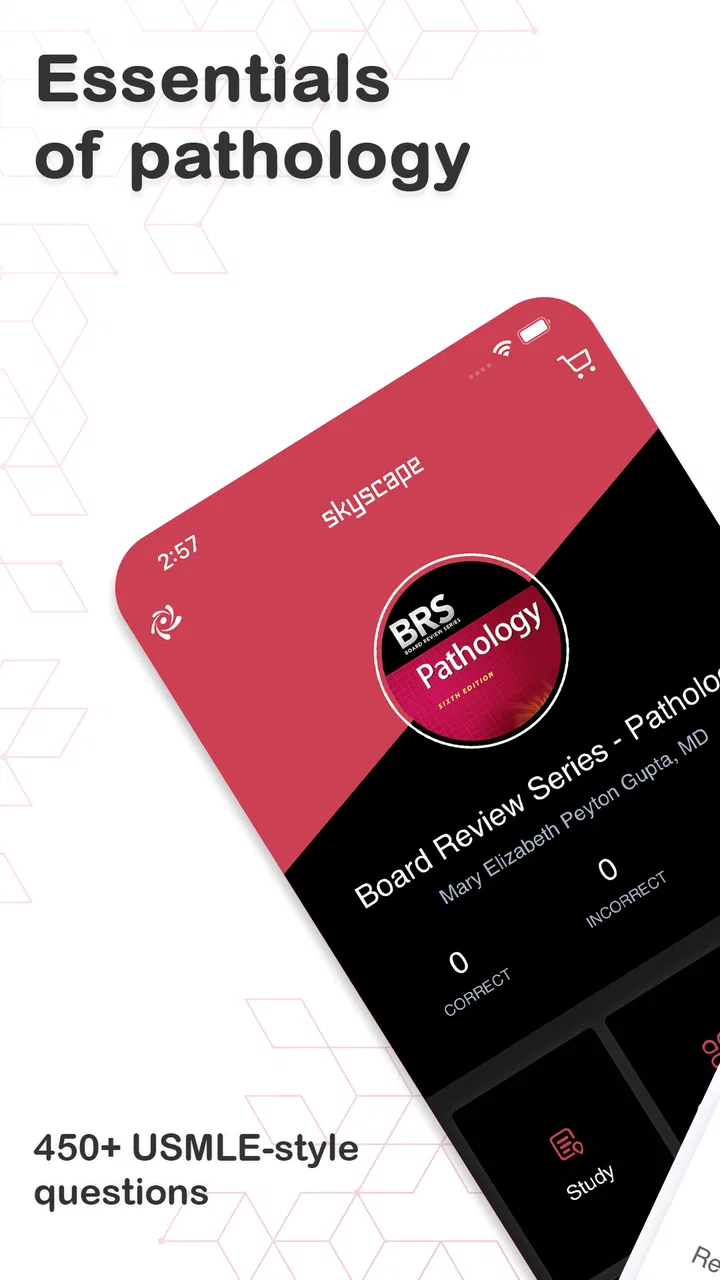
Board Review Series-Pathology
- 0.0
- Rating
- 10.00K
- Installs
- Free
- Price

 Analysis by App-foxy
I approached Board Review Series-Pathology as a focused study companion rather than a general medical reference. It is a free medical app from Skyscape Medpresso Inc., built around board-style pathology practice and explanations. The central appeal is straightforward: instead of passively reading a long chapter, I can test whether I recognize the disease process, make a choice, and then inspect the reasoning behind the answer.
That difference matters when studying pathology. Reading can create a comfortable feeling of familiarity, while questions expose whether I can actually connect morphology, mechanism, clinical presentation, and diagnosis. The app’s store summary points to more than 450 USMLE-style questions, with answers and rationales placed at the end of the chapters. In practice, that makes it most useful as a structured review tool for medical students and other learners preparing for demanding examinations, not as a replacement for a complete pathology textbook.
The app is free to install and suitable for Everyone, although individual in-app items range from $29.99 to $44.99. It has a modest footprint in the medical-app space, with over 10 thousand installs, and the current version is 4.16.0. It runs on Android devices using version 5.0 or later. Those details make it accessible to people using older hardware, but the real question is whether its question-and-rationale format fits the way you study.
You May Also Like

 Pandora - Music & Podcasts
Pandora’s Music Is Easy to Start, but Harder to Recover
Pandora’s strength is its low-effort path from a seed to a station. Its weak spot is how much confidence it asks you to place in connection, setup, and quiet recovery.

 8 Ball Pool
 Is Built on Rivalries, Rematches, and Routine
A close look at the rivalries, rematches, shared routines, and unanswered safety questions that turn a quick pool match into a persistent mobile community.

 Samsung Music
’s Quiet Strength Is Playing What You Already Own
Its reach comes less from spectacle than from dependable access to a personal library. That simplicity is both the app’s strongest retention engine and its ceiling.

 AccuWeather: Weather Radar
AccuWeather Review: A Quick, Clear Forecast for Everyday Decisions
For everyday plans, the best forecast is the one you can understand quickly. AccuWeather makes rain timing, radar, and local conditions easy to act on, with a few trade-offs.

 Hill Climb Racing
Why Hill Climb Racing Still Turns Crashes Into One More Run
A tiny car, a bumpy hill and one more upgrade: Hill Climb Racing keeps resurfacing because its simple chaos makes every near-miss feel personal.

 AliExpress - Shopping App
AliExpress Makes Global Shopping Feel Personal, but Shoppers Bear the Risk
AliExpress turns a global marketplace into a pocket-sized discovery engine. Its reach is useful, its shopping loop compelling, and its trade-offs easy to miss.
More From Our News Desk
View All News


How connectivity changes the study experience
I use connectivity as a planning cue rather than assuming every study moment will be equally smooth. Before a commute or a long day away from reliable Wi-Fi, I would open the chapter I intend to study and make sure I can reach the material I need; that small check helps protect a short session from turning into troubleshooting. It also leads to a useful question about handoffs: how to carry a missed concept from the app into deeper study.
What I expect when a study session depends on a connection
The first thing I would keep in mind is that an app like this is not simply a paper question bank placed on a phone. Installation, updates, account-related actions, and access to any purchased material can involve connectivity, so I would prepare before relying on it during a tightly scheduled study block. I would not assume that every part of the experience remains available in a poor-signal environment unless the app itself clearly indicates that it does.
That is especially relevant in medical study settings. A learner may open the app in a hospital cafeteria, on public transport, in a library with crowded Wi-Fi, or between lectures. A weak connection can turn a quick review into a frustrating wait if a chapter or question set has not already loaded. My practical approach would be to open the material while I have a stable connection, move through the first few screens, and check what remains accessible before leaving reliable internet.
This is not a criticism of the pathology content itself. It is a reminder that connectivity can become part of the workflow. A question bank is most valuable when it is ready at the exact moment I have ten spare minutes. If preparation is needed each time, the app loses some of the spontaneity that makes mobile study attractive.
Why the chapter-based arrangement affects online use
The placement of answers and rationales at the end of chapters creates a useful separation between testing and reviewing. I can work through a group of questions without immediately seeing the explanation, then move to the rationale section when I am ready to analyze mistakes. That arrangement encourages a more honest attempt than a format that reveals the answer after every tap.
It also means I would avoid jumping randomly through the material when my connection is unreliable. A better routine is to choose a chapter before starting, complete a manageable batch, and then review the explanations in one sitting. This reduces repeated loading and gives the session a clear beginning and end. It also makes it easier to note which concepts need attention later in a larger reference book.
Using it in short mobile sessions
On a phone, the app makes the most sense for active recall rather than deep first-pass learning. I would use it after studying a pathology topic elsewhere, during a commute, or while waiting for a class to begin. The question format gives those small gaps a purpose: instead of scrolling through unrelated material, I can ask myself whether I understand the clinical clues and the underlying pathology.
A realistic example would be a student who has spent the evening reviewing renal disease and has a short break the next morning. Rather than rereading the same notes, the student opens the relevant chapter, answers a few questions without checking the rationale, and marks the concepts that caused hesitation. Later, at a desk with a textbook available, those weak areas can be studied in greater depth. The app works well in that sequence because it acts as a diagnostic checkpoint.
I would not use it as my only resource during a long study day. A phone screen is convenient, but it is not always the best place to compare several diagrams, build a detailed differential diagnosis, or follow a complicated mechanism across multiple pages. The app is strongest when it prompts retrieval and exposes gaps, while a textbook, lecture, or larger reference fills those gaps.
When a tablet is a better fit
A larger screen should make reading rationales more comfortable, particularly when an explanation requires careful comparison between the question stem and the answer choices. That does not transform the app into a full reference platform, but it can reduce the visual friction of extended review. If I were choosing between a phone and tablet, I would use the phone for quick questions and the tablet for a longer chapter review.
The trade-off is portability. A phone is always close at hand, while a tablet is easier to leave behind. For that reason, I see the best setup as flexible rather than exclusive: short recall sessions on the phone, deliberate explanation review on the larger device, and a separate source for detailed teaching. The value comes from assigning each tool a clear job.
Handling interruptions without losing the point of the session
Mobile study is often interrupted by messages, calls, low battery, or the need to move between locations. I would therefore avoid opening a question set moments before an important appointment. Instead, I would begin with a small target, such as one chapter segment or a defined number of questions, and treat completion of that target as the session’s finish line.
This approach also protects against a common problem with question banks: answering quickly without learning from the result. If I have only a minute, I would rather complete one question and understand its rationale than rush through several and remember nothing. The app’s chapter-end explanations support that slower, more reflective use.
What happens when access is interrupted
If a connection drops, I would first avoid repeatedly tapping the same control. Repeated attempts can make it difficult to tell whether the app is processing a request or simply waiting. I would give the screen a moment, return to the previous section if possible, and reopen the chapter once the connection is stable. This is basic advice, but it matters when a study session is already squeezed between other responsibilities.
I would also keep a simple external note of the last chapter and question I reviewed. That is not glamorous, but it makes recovery easier if the app closes or the session does not return exactly where I expected. A short note such as “reviewed inflammatory disease; revisit mechanism question” preserves the learning plan even when the mobile session does not.
For purchased content, I would be especially careful to complete any required access or restoration steps while online and before an exam-week study session. The app’s free installation does not mean every piece of material is included at no cost, so I would check the available content and the purchase screen before building a study schedule around a particular chapter.
Being sensible with mobile data
I would use Wi-Fi for installation, updates, and any substantial content access whenever possible. This is less about the app being unusually demanding and more about avoiding surprises on a limited mobile plan. A student may spend many short sessions in the app, and small online actions can add up when repeated every day.
The most data-conscious workflow is also the most academically useful: select the topic in advance, open it on a dependable connection, answer deliberately, and review the rationales in a single focused block. I would avoid constantly switching between chapters just because the phone is available. That behavior is inefficient for learning and may create more loading activity than a planned session.
Notifications and background behavior can also affect concentration, although the exact controls depend on the device and operating system. I would silence unrelated alerts during a question set and keep the session short enough to maintain attention. Pathology questions often hinge on one detail in the stem, so divided attention can produce a misleading result: I may blame my knowledge when the real problem was that I read too quickly.
How the app compares with familiar alternatives
Compared with a printed review book, this app is easier to carry and better suited to opportunistic questioning. A book is more dependable when I want a stable, uninterrupted reading experience and the ability to annotate freely. It also avoids the uncertainty that can come with a fragile connection. The app wins when I need practice in a waiting room or between commitments.
Compared with a broad medical reference app, Board Review Series-Pathology is narrower and more exam-oriented. A general reference is usually the better choice when I need to verify a rare condition, inspect a full definition, or read beyond the boundaries of a review chapter. This app is better when I already have a topic in mind and want to find out whether I can apply it under question pressure.
Compared with a large subscription question bank, its appeal is concentration. A wider platform may offer more subjects, elaborate performance tracking, or a larger ecosystem, but it can also make pathology review feel scattered. Here, the chapter structure and rationales keep attention on one discipline. The trade-off is that learners seeking a single all-in-one exam platform may find this focused approach too limited.
Who will benefit most from the question-and-rationale format
I would recommend it first to medical students who have already encountered core pathology concepts and need to test retention. It can also suit learners preparing for USMLE-style examinations who want a portable way to practice clinical reasoning. The questions are more useful when the user pauses to explain why each option is right or wrong, rather than treating the app as a speed test.
The rationales are particularly important for students who miss questions for different reasons. A wrong answer caused by forgetting a mechanism requires a different response from a wrong answer caused by overlooking a clinical clue. I would keep a mistake log with three columns: the topic, the clue I missed, and the correction. That turns the app from a sequence of isolated questions into a map of recurring weaknesses.
Another useful method is to revisit a difficult chapter after a delay instead of repeating it immediately. Immediate repetition can create recognition without genuine recall. Waiting until the next study day, then attempting the questions before reading the explanations, gives a more honest measure of whether the concept stayed with me.
Who should choose something else
I would skip this app as a primary resource if I were just beginning pathology and needed extensive teaching before attempting questions. A question bank can reveal confusion, but it may not provide the full visual and conceptual scaffolding required to build the subject from the ground up. In that situation, I would start with a structured course or comprehensive textbook and use this app afterward.
I would also look elsewhere if my main priority were detailed progress analytics, broad multi-subject coverage, or a fully integrated exam schedule. The focused pathology approach is a strength for some users, but it is not automatically the best fit for someone who wants one platform to manage every part of preparation.
Cost deserves a realistic look as well. The app itself is free, which makes trying the basic experience relatively easy, but optional items priced from $29.99 to $44.99 each can change the overall value. I would inspect exactly which material is included before purchasing and compare that cost with a book or a broader question service I already use. The right choice depends on whether the additional chapter content fills a specific gap in my preparation.
My practical routine with it
My preferred routine would begin with a clear topic rather than an aimless browse. I would study the subject from a primary source, use the app to answer a small set of related questions, and read every rationale, including explanations for answers I got right by guessing. Then I would write down only the concepts that changed my understanding or exposed uncertainty.
For a busy weekday, I would divide the work into three stages. First, I would open the selected chapter while connected to dependable Wi-Fi. Second, I would answer without consulting notes. Third, I would review the explanations and record one corrective takeaway per missed concept. This keeps the app from becoming a passive reading tool and makes its limited mobile format work in its favor.
I would reserve longer sessions for comparing the rationales with a trusted pathology reference. If an explanation introduces a distinction I cannot fully explain, that is a signal to leave the app and study the underlying topic. Returning later for another attempt is more productive than forcing the app to answer a question it was not designed to answer completely.
My connectivity verdict
Board Review Series-Pathology is a useful, focused companion for learners who want pathology questions available in short mobile sessions. Its strongest contribution is the combination of exam-style prompts and chapter-end reasoning: I can test recall, identify a weak point, and then investigate why the answer works. That is more valuable than simply collecting correct responses.
Connectivity shapes how smoothly that process happens. I would prepare chapters before leaving reliable Wi-Fi, avoid assuming access in every low-signal location, and keep an external note of my study position. Those small habits reduce the chance that a technical interruption breaks the learning rhythm. They also make the free app more practical for commuters, students between classes, and anyone studying around clinical responsibilities.
My bottom line: I would recommend it as a targeted pathology review tool, not as a complete medical library or a substitute for foundational teaching. The free entry point is appealing, the Android compatibility is broad, and the focused question format can make spare minutes genuinely useful. Still, the optional purchases require a careful look, and learners who need extensive explanations, visual teaching, or broad exam management may be better served by another resource alongside it.
For the right user, the app earns its place by answering a practical question: can I apply what I studied when the wording changes and the clues compete for attention? If the answer is not yet yes, this is the kind of practice that can show exactly where to improve. I would use it deliberately, with a stable connection when possible and a larger reference nearby for deeper follow-up.
FAQs for Board Review Series-Pathology
01What is Board Review Series-Pathology, and who is it designed for?
Board Review Series-Pathology is a medical study resource focused on high-yield pathology concepts commonly tested in medical school and board examinations. It is primarily intended for medical students, especially those preparing for pathology coursework, USMLE-style exams, or other medical licensing tests. The material is organized for review rather than for teaching every topic from the beginning, so learners benefit most when they already have basic pathology knowledge.
02What kind of study content does Board Review Series-Pathology include?
The app generally presents concise explanations of important pathology subjects, including disease mechanisms, morphologic changes, clinical findings, and exam-focused associations. Its content is designed to help users review major concepts efficiently, often through structured chapters, summaries, and practice-style questions. Because the exact features can vary by edition or platform, users should check the current app description to confirm whether their version includes quizzes, explanations, progress tracking, or other interactive tools.
03Can Board Review Series-Pathology be used as a complete pathology textbook?
It is better viewed as a high-yield review companion than as a complete replacement for lectures, a comprehensive pathology textbook, or guidance from a medical instructor. The concise format is useful for reinforcing essential facts and identifying frequently tested relationships, but it may not provide the depth needed to understand every disease or unusual presentation. Students should combine it with class materials, question banks, diagrams, and reputable clinical references.
04Is Board Review Series-Pathology suitable for beginners?
Beginners can use Board Review Series-Pathology, but the experience may be challenging if they have not yet studied basic pathology, physiology, and anatomy. The resource often assumes familiarity with medical terminology and focuses on rapid consolidation of information rather than lengthy introductory explanations. New learners should consider studying foundational material first, then using the app to review key concepts and test their retention as their course progresses.
05Does the app work offline, and is all content available after downloading it?
Offline access depends on the specific version, licensing model, and the way the publisher distributes the content. Some study sections may be available after installation, while other features could require an internet connection, an account, in-app purchases, or additional downloads. Before installing, review the store listing for device requirements, subscription details, privacy information, and offline-use limitations, particularly if you plan to study while traveling or without reliable mobile data.
Pros
- Concise format makes last-minute pathology revision more manageable.
- Useful for identifying high-yield topics commonly tested in medical exams.
- Practice questions help reinforce recognition of classic disease patterns.
- Clear explanations can support independent study without constant guidance.
- Portable digital access makes reviewing during commutes or breaks convenient.
Cons
- Content may feel too condensed for learners building pathology knowledge from scratch.
- Some explanations may require a separate textbook for deeper clinical context.
- Question difficulty may not match every school’s curriculum or examination style.
- Extended reading on a phone can be tiring without a larger-screen device.
- Regular updates may be needed to reflect changing diagnostic classifications.

Board Review Series-Pathology
Gallery